
American Rescue Plan Act (ARPA) Update: What ARPA Funds Supported at IVIH (and the Results)
IVIH’s work is community-facing, so our reporting should be too. This is a living ARPA summary: what the funding supported, what we delivered, and the outcomes we tracked. We’ll update it as we add supporting documents and deeper breakdowns.
ARPA in Plumas County: the basics
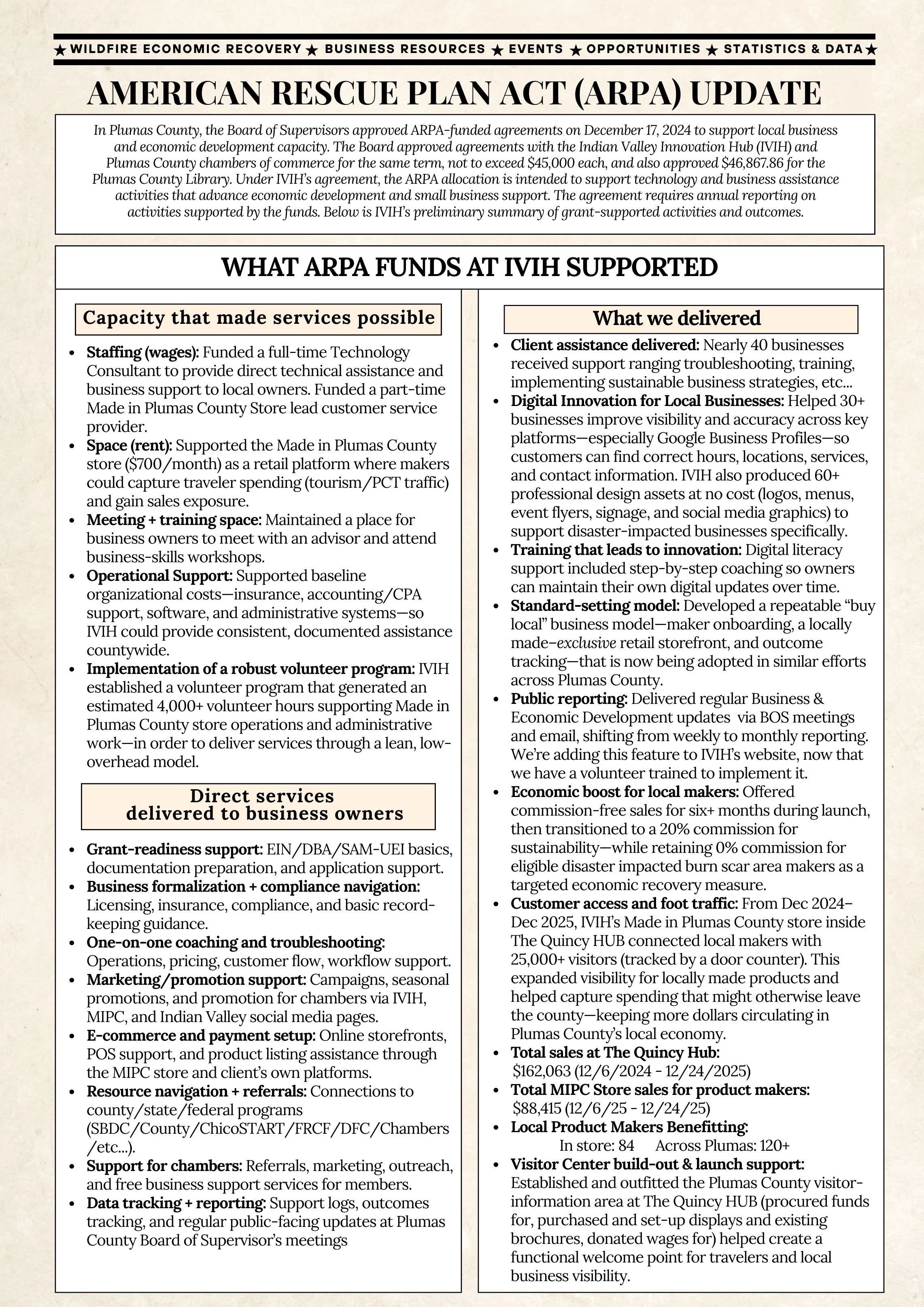
The American Rescue Plan Act (ARPA) is federal economic recovery funding created to help communities respond to COVID-era disruption and strengthen local capacity—especially where small businesses and local services were hit hard. In Plumas County, the Board of Supervisors approved ARPA-funded agreements on December 17, 2024 to support local business and economic development capacity. The Board approved agreements with:
• Indian Valley Innovation Hub (IVIH): not to exceed $45,000
• Plumas County Chambers of Commerce (each): not to exceed $45,000 (same term)
• Plumas County Library: $46,867.86
Under IVIH’s agreement, ARPA supported technology and business-assistance activities that advance economic development and small business support, with annual reporting required on the activities supported by the funds.
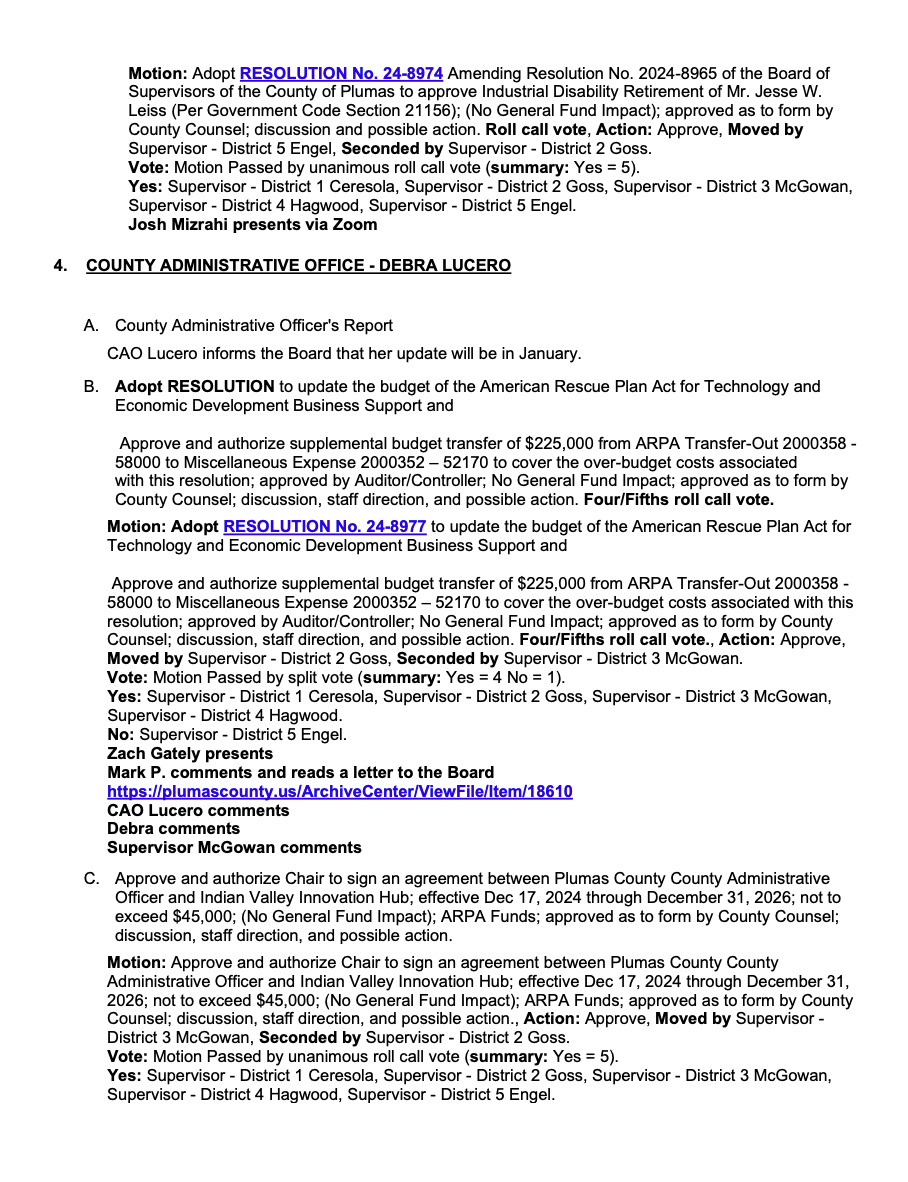
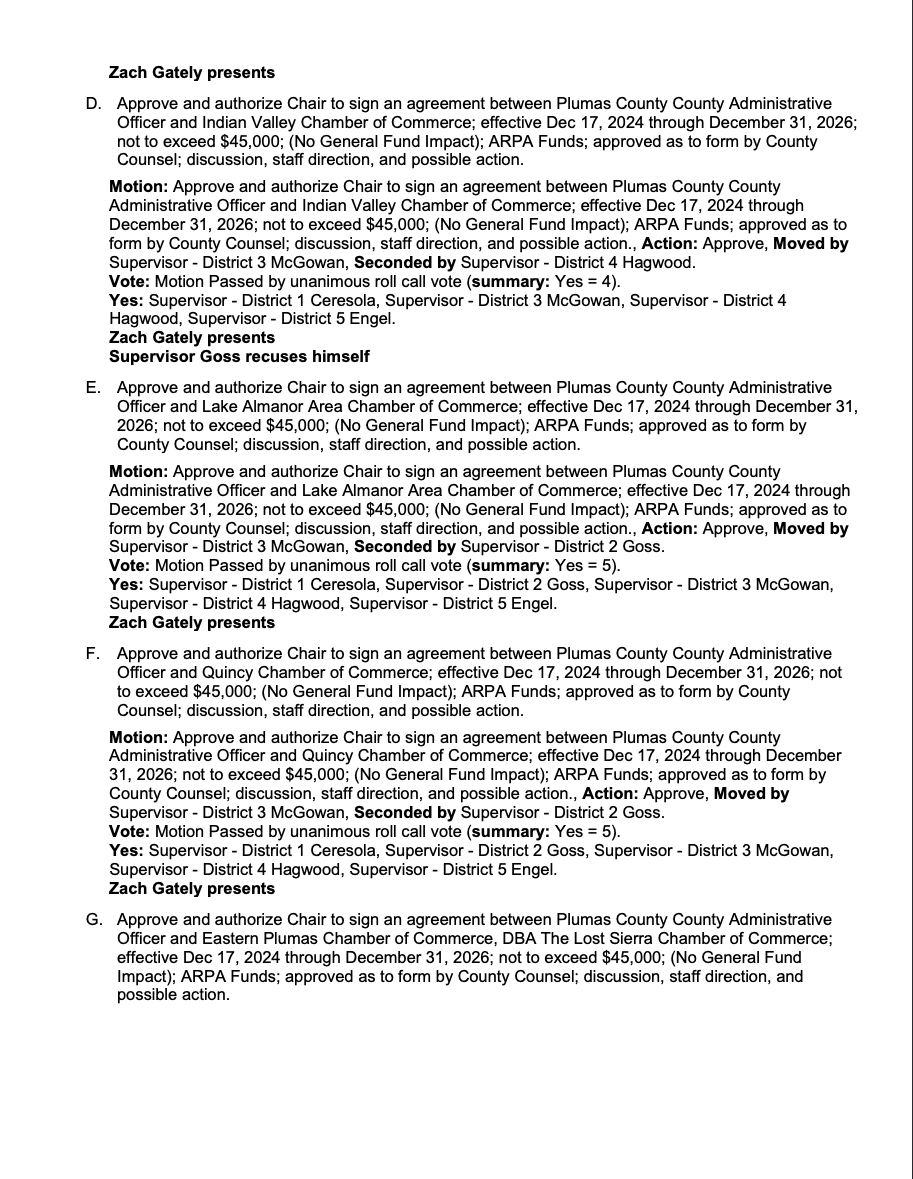
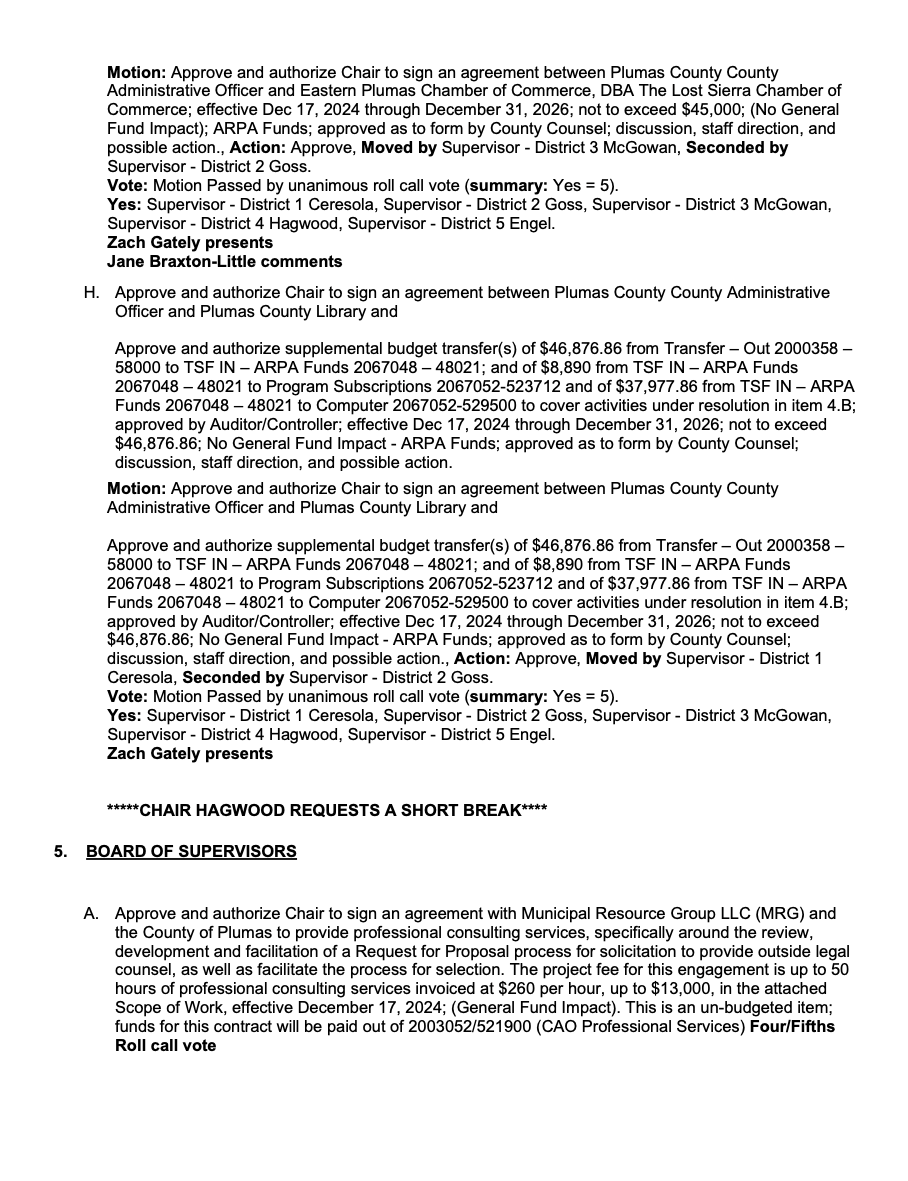
Public record reference (Board of Supervisors minutes excerpt):
The images below are excerpts from the Plumas County Board of Supervisors meeting record dated December 17, 2024. They show the agenda items and motions authorizing ARPA-funded agreements with IVIH and the Plumas County chambers of commerce, and the ARPA-funded budget action supporting technology and economic development business support.
https://plumascoca.portal.civicclerk.com/event/1571/files/agenda/5602
Economic access: what it looks like in a rural county
“Economic access” can sound abstract until you see what it means in a rural place like Plumas County.
It means a small business owner can:
Go digital and get visible online without hiring an agency, so their business can actually be found by locals and travelers.
Correct and manage the core profiles that drive real customer decisions—Google Business Profile, Apple Maps (Apple Business Connect), Bing Places, Yelp, and Facebook/Instagram—so people see accurate hours, locations, services, and contact information.
Understand basic compliance and business setup steps without needing expensive consulting—so paperwork and process don’t become a barrier to survival.
Set up payment systems, product listings, and basic operating systems that make it easier to sell, track performance, and build consistency.
Get coaching and troubleshooting support that helps owners make smarter decisions month after month—pricing, customer flow, workflow, and sustainability strategies.
That’s not dependency on public funds—it’s capacity-building. It’s how we help small businesses strengthen their foundation, compete more fairly, and stay sustainable over time.
Community-powered model: countywide volunteer support
One reason this model has stayed lean and effective is the community behind it. Community-minded folks from Quincy, Twain, Meadow Valley, Chester, Keddie, Crescent Mills, Genesee, Taylorsville, and Greenville have contributed over 4000 volunteer hours in the past year to support business and maker programming—everything from store operations to behind-the-scenes administrative work (like writing this blog post) that helps our Plumas County small businesses succeed.
It’s also important to clarify the funding type: ARPA is federal economic recovery funding, not wildfire recovery funding. We used it to build a countywide model that provides free support for producers and small business owners across Plumas County, while still offering targeted measures for those most impacted by wildfire.
What this looks like in real outcomes
We track outcomes like visitor counts, sales, and services delivered so we can measure whether this work is producing real economic value for local makers, small businesses, and the broader local economy.
Targeted recovery by looping in the little guy
This model is designed to lift the broader local business ecosystem while still delivering targeted support for those hit hardest by wildfire impacts. As a targeted recovery measure, IVIH has offered commission-free participation for eligible makers in the Dixie Fire burn scar area, helping them keep more of each sale as they rebuild homes, businesses, and local economic stability.
Since the inception of Made in Plumas County (July 2023), our goal has been simple: expand customer access, increase income for product makers, and keep dollars circulating locally—so fewer dollars leak out of Plumas County and more stay in local pockets. Plumas County is dealing with an economic crunch countywide, so we’re building systems that strengthen the whole ecosystem while providing focused support where the wildfire impacts hit hardest.
What we delivered and what we tracked
• Nearly 40 businesses (not only product makers) received support ranging from troubleshooting and training to implementing sustainable strategies.
• 30+ businesses received “digital visibility” support to improve accuracy and discoverability across multiple core online platforms like Google
• 60+ professional design assets were produced at no cost (logos, menus, flyers, signage, social graphics), targeting disaster-impacted businesses.
• From Dec 2024–Dec 2025, the Made in Plumas County store inside The Quincy Hub connected local products with 25,000+ visitors (tracked by a door counter).
SALES OUTCOMES
(12/6/2024–12/24/2025)
• Total sales at The Quincy Hub: $162,063
• Total Made in Plumas County store sales for product makers: $88,415
• Product makers benefiting: 84 in-store, 120+ across Plumas County
How This Funding Strengthened Local Businesses
Did these public dollars create lasting capacity and a measurable return?
This one did, because it focused on:
• skills & systems that outlast the grant period,
• practical help that levels the playing field for small operators,
• and outcomes that can be tracked (businesses served, assets produced, visitors counted, sales recorded).
That’s what responsible investment looks like: small inputs that unlock longer-term resilience.
Methods and documentation
To keep our reporting consistent, Jake (our Technology Consultant) set up a data-tracking system at The Quincy Hub that helps us measure visitor traffic, engagement, and outcomes over time. We’ve also seen other local organizations recognize the value of this approach and begin implementing similar basic tracking systems (visitor counts, maker participation, and sales/activity metrics) to improve reporting and decision-making.
Visitor counts: door counter at The Quincy Hub
Visitor log: volunteers and staff greet customers and record basic visit statistics
Visitor origin tracking: a “Map of the World” where visitors place a pin to show where they’re visiting from
Conversion rate: we compare total door traffic to total sales to estimate conversion (visitors → purchases)
Sales totals: recorded through the Square platform for The Quincy Hub and the Made in Plumas County store
Businesses served + services delivered: tracked through logs and documented interactions
Design assets: tracked by deliverables produced (logos, menus, flyers, signage, social media graphics)
Promotional activity tracking: we track the number of times IVIH/Made in Plumas County and the community pages we manage promote local businesses and product makers across our social media platforms (posts, shares, and business/maker features), including basic engagement totals when available (e.g., reach, clicks, and shares).
This helps ensure our decisions are driven by measurable outcomes—not just anecdotes.
Conclusion
ARPA helped IVIH build capacity that small businesses can actually use—digital visibility, practical troubleshooting, basic systems, and ongoing support that strengthens sustainability over time. Just as importantly, this work was amplified by a countywide volunteer effort that kept overhead low and energy high.
We’re publishing this as a living summary because community-facing work should be reported clearly, with outcomes that can be tracked. We’ll continue updating this post as we add supporting documents, refine our public archive, and share deeper breakdowns of results.